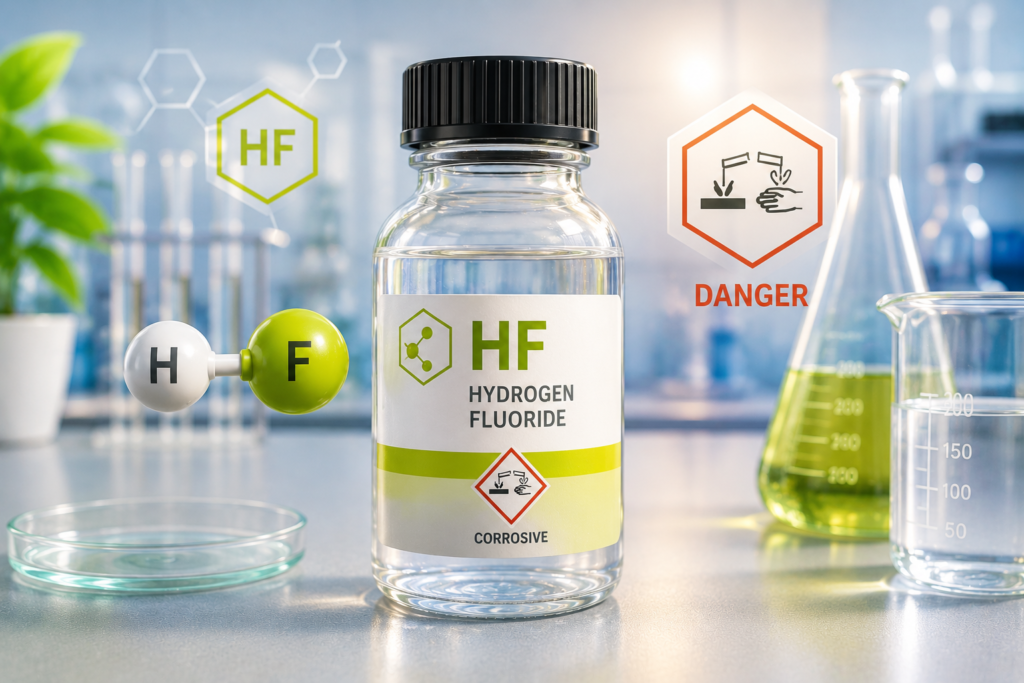
Hydrogen Fluoride (HF): Properties, Industrial Uses, Health Risks, and Safety Guidelines
Introduction
Hydrogen Fluoride (HF) is one of the most important yet dangerous industrial chemicals used in modern manufacturing and chemical processing. It plays a crucial role in industries such as oil refining, metal processing, electronics manufacturing, glass etching, and mineral extraction. Despite its usefulness, HF is also classified as a highly toxic and corrosive substance that can cause severe health effects even at very low exposure levels.
HF exists as a colorless gas or as a fuming liquid and reacts violently with water, forming hydrofluoric acid. This reaction significantly increases its corrosive potential and toxicity, making it a substance that requires strict industrial control and safety management.
Chemical Nature and Physical Properties of Hydrogen Fluoride
Hydrogen Fluoride is composed of one hydrogen atom bonded to one fluorine atom. While this structure seems simple, its behavior is chemically unique compared to other hydrogen halides.
HF has a strong ability to form hydrogen bonds, which gives it unusually high boiling and melting points compared to similar compounds. It can exist in multiple states depending on temperature and pressure, including gas, liquid, and aqueous solution.
Key properties of HF include:
- Highly polar covalent molecule
- Strong hydrogen bonding capability
- Highly soluble in water
- Forms hydrofluoric acid when dissolved
- Extremely reactive with silicon-based materials (glass, quartz)
One of the most important chemical behaviors of HF is its ability to dissolve silica (SiO₂), which is why it can etch glass—a property widely used in industrial applications.
Industrial Importance of Hydrogen Fluoride
Hydrogen Fluoride is a cornerstone chemical in modern industry. It is used as a precursor for numerous fluorine-containing compounds and plays a central role in refining and manufacturing processes.
Its applications span across multiple sectors, including:
- Petrochemical refining processes
- Production of refrigerants and fluoropolymers
- Metal surface treatment and cleaning
- Semiconductor fabrication
- Glass etching and polishing
- Uranium processing in nuclear fuel production
- Mining and ore refinement
Without HF, many modern technologies—especially in electronics and energy production—would not be possible.
Industrial Applications Explained
HF is valued because of its ability to react with compounds that are otherwise very stable. This makes it ideal for both destructive and precision industrial processes.
It is commonly used to:
- Remove oxides from metal surfaces
- Etch micro-patterns in silicon wafers
- Produce high-performance fluorinated materials
- Refine petroleum products by alkylation
- Process rare minerals and ores
These applications make HF an essential but tightly controlled industrial chemical.
Industrial Usage Overview
Below are structured comparisons of HF usage across industries.
| Oil & Fuel Industry | Used in alkylation processes to improve fuel quality |
|---|---|
| Mining Industry | Used in extraction and purification of minerals |
| Electronics Industry | Used in semiconductor wafer etching and cleaning |
|---|---|
| Glass Industry | Used for controlled etching and frosting of glass |
Three-point industry summary list (3 items)
- Chemical industry: production of fluorinated compounds and intermediates
- Metallurgy: surface cleaning and oxide removal from metals
- Nuclear industry: uranium processing for nuclear fuel cycles
Hydrofluoric Acid Formation
When hydrogen fluoride is dissolved in water, it forms hydrofluoric acid (HF(aq)), which is even more hazardous due to its ability to penetrate biological tissues and react with calcium and magnesium in the body.
This reaction increases both:
- Corrosivity
- Biological toxicity
Unlike many acids, HF does not only burn the surface of tissues—it penetrates deeply and continues damaging internal structures.
Health Hazards and Toxic Effects
Hydrogen Fluoride is one of the most dangerous industrial cHydrogen Fluoride (HF): Properties, Uses, and Health Risks
Introduction to Hydrogen Fluoride (HF)
Hydrogen Fluoride (HF) is a highly toxic and corrosive industrial chemical widely used in oil refining, metal processing, glass etching, semiconductor manufacturing, and chemical production. It is one of the most important fluorine-based compounds in modern industry, enabling processes that would otherwise be impossible with conventional chemicals.
HF exists as a colorless gas or fuming liquid. When dissolved in water, it forms hydrofluoric acid, which is even more dangerous due to its ability to penetrate deep into biological tissue and attack internal structures.
Despite its industrial importance, Hydrogen Fluoride (HF) is classified as extremely hazardous because even low-level exposure can cause serious health effects.
Hydrogen Fluoride (HF) Chemical Structure and Properties
Hydrogen Fluoride has a simple molecular structure but extremely complex behavior.
Alt text: Hydrogen Fluoride (HF) molecular structure showing one hydrogen atom bonded to fluorine in a polar covalent bond
HF is highly polar and forms strong hydrogen bonds, which gives it unusual physical properties compared to other hydrogen halides.
Key properties of Hydrogen Fluoride (HF)
- Highly polar covalent molecule
- Strong hydrogen bonding capability
- Forms hydrofluoric acid in water
- Highly reactive with silica and glass
- Extremely corrosive and toxic even in low concentrations
HF’s ability to dissolve silicon dioxide (SiO₂) makes it essential in semiconductor manufacturing and glass processing industries.
Hydrogen Fluoride (HF) Industrial Uses and Applications
Hydrogen Fluoride (HF) is used across a wide range of industries due to its reactivity and chemical versatility.
Main industrial applications include:
- Oil refining (alkylation processes)
- Glass etching and polishing
- Semiconductor wafer manufacturing
- Metal cleaning and oxide removal
- Refrigerant and fluorochemical production
- Mining and mineral processing
- Nuclear fuel processing
HF is especially valuable in precision industries where controlled chemical reactivity is required.
Hydrogen Fluoride (HF) Industry Breakdown (HTML Tables)
Chemical & Energy Industry
| Oil Refining | Used in alkylation to improve gasoline octane rating |
| Chemical Production | Used to produce fluorinated compounds and polymers |
Electronics & Materials Industry
| Electronics Industry | Used in silicon wafer etching for microchips |
| Glass Industry | Used for precision glass etching and surface finishing |
Additional Industrial Uses
| Mining Industry | Used for mineral extraction and ore purification |
| Nuclear Industry | Used in uranium processing for nuclear fuel cycles |
Hydrogen Fluoride (HF) Health Risks and Toxicity
Hydrogen Fluoride is extremely dangerous to human health. Exposure can occur via inhalation, ingestion, or skin contact.
Even concentrations above 2 ppm can cause irritation and early signs of respiratory damage.
Health effects of Hydrogen Fluoride (HF):
- Severe chemical burns on skin
- Deep tissue destruction beyond surface exposure
- Eye damage and potential permanent blindness
- Lung damage and respiratory failure
- Systemic toxicity affecting organs
- Disruption of calcium and magnesium balance
HF is particularly dangerous because it may not cause immediate pain, allowing exposure to continue unnoticed.
Hydrogen Fluoride (HF) Toxic Mechanism
Once HF enters the body, fluoride ions bind with calcium and magnesium ions, which are essential for nerve signaling and muscle function.
This leads to:
- Cellular breakdown
- Electrolyte imbalance
- Cardiac arrhythmias
- Tissue necrosis
- Multi-organ toxicity
Unlike many acids, HF’s toxicity is systemic, not just local.
Environmental Impact of Hydrogen Fluoride (HF)
Hydrogen Fluoride released into the environment can cause significant ecological damage.
Environmental risks include:
- Air pollution near industrial zones
- Soil fluoride accumulation
- Water contamination
- Plant and vegetation damage
- Long-term ecosystem disruption
Hydrogen Fluoride (HF) Safety Measures
Strict safety protocols are essential when handling Hydrogen Fluoride (HF).
Safety precautions:
- Chemical-resistant protective suits
- Specialized HF-resistant gloves
- Respiratory protection systems
- Continuous air monitoring systems
- Emergency calcium gluconate treatment availability
- Trained hazardous material response teams
Hydrogen Fluoride (HF) Emergency Response
Immediate action is critical in HF exposure incidents.
👉 Official safety guidance:
https://www.cdc.gov/niosh/topics/hydrogenfluoride/
Emergency procedures:
- Immediate removal from exposure area
- Thorough washing with water
- Application of calcium-based antidotes
- Urgent medical treatment
- Continuous monitoring of symptoms
Delays in treatment can significantly increase the severity of injury.
Hydrogen Fluoride (HF) Compared to Other Acids
Hydrogen Fluoride is often considered more dangerous than strong mineral acids due to its unique biological behavior.
Unlike sulfuric or hydrochloric acid, HF:
- Does not always cause immediate pain
- Penetrates deeply into tissues
- Affects internal organs via fluoride ions
- Causes systemic toxicity rather than surface-only damage
Conclusion
Hydrogen Fluoride (HF) is a critical industrial chemical used in modern technologies such as electronics, fuel production, metallurgy, and chemical manufacturing. Its unique chemical properties make it indispensable in many industries.
However, its extreme toxicity, corrosive nature, and ability to cause systemic poisoning make it one of the most dangerous chemicals in industrial use. Strict safety protocols, proper handling, and emergency preparedness are essential to minimize risk.
Related products and applications:
GASERA ONE HF
HF (Hydrogen Fluoride) Monitoring in Ambient Air