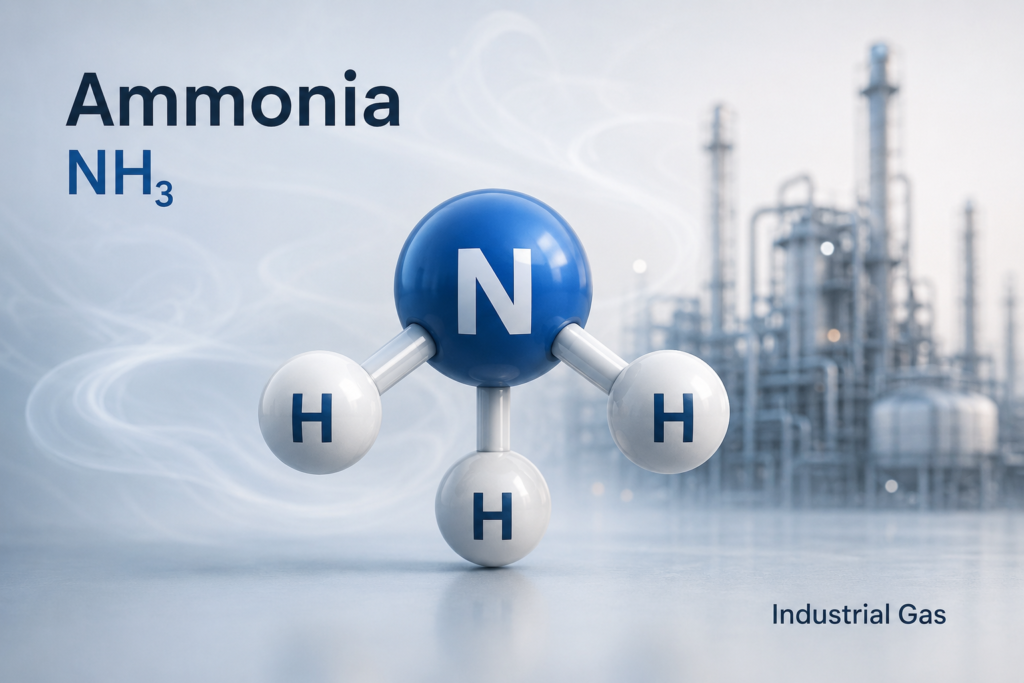
Ammonia (NH₃): Properties, Industrial Uses, Health Effects and Environmental Impact
Introduction
Ammonia (NH₃) is a colorless, pungent industrial gas that plays a crucial role in global agriculture, chemical production, and refrigeration systems. It is one of the most widely produced industrial chemicals in the world and a key component in modern food production systems through fertilizer manufacturing.
Although highly useful, ammonia is also a reactive alkaline gas that can cause irritation and environmental impact when released in high concentrations.
Chemical Characteristics
Ammonia is a small nitrogen-hydrogen compound with strong polarity and high solubility in water. It forms ammonium hydroxide when dissolved, creating an alkaline solution widely used in industrial chemistry.
Alt text Ammonia NH3 molecular structure industrial gas chemistry diagram
Key characteristics:
Colorless gas with strong odor
Highly soluble in water
Forms alkaline solutions
Lighter than air
Reactive with acids to form ammonium salts
Corrosive in high concentrations
Unlike acidic industrial gases, ammonia behaves as a base, which makes it chemically unique in industrial applications.
Natural and Industrial Sources
Ammonia is present in both natural ecosystems and industrial environments.
Natural sources include:
Organic decomposition
Animal waste
Soil microbial activity
Human-related sources include:
Agricultural fertilizers
Livestock farming
Industrial production
Refrigeration systems
Waste treatment facilities
Agriculture remains the dominant global source of emissions.
Industrial Importance
Ammonia is one of the most important building blocks in modern industry, especially in nitrogen-based chemistry.
It is used in:
Fertilizer production (urea and ammonium compounds)
Industrial refrigeration systems
Chemical synthesis processes
Cleaning and disinfecting products
Textile and material processing
Its role in agriculture alone makes it essential for global food supply chains.
Industrial Applications Table
| Agriculture | Used to produce fertilizers that support global crop production | Essential for food security worldwide | Major source of emissions |
| Refrigeration | Used as an efficient natural refrigerant in cooling systems | High energy efficiency compared to synthetic gases | Leak risk in confined spaces |
| Chemical Industry | Used in production of acids, plastics and nitrogen compounds | Among the top industrial chemicals globally produced | Corrosive exposure potential |
| Cleaning Products | Used in degreasers and household cleaners | Highly effective grease removal agent | Respiratory irritation risk |
| Textile Industry | Used in fabric processing and finishing | Improves durability and dye absorption | Workplace exposure control required |
Health Effects and Exposure Risks
Exposure to ammonia can irritate the eyes, skin, and respiratory system. Effects depend on concentration and duration of exposure.
Health effects include:
Eye irritation and burning
Throat and nose irritation
Coughing and breathing difficulty
Chest tightness
Severe lung damage at high exposure
Skin burns in liquid form
Even low-level exposure can cause noticeable irritation due to its strong alkaline nature.
Mechanism of Action
When ammonia enters the body, it dissolves in moisture and forms ammonium hydroxide, which is strongly alkaline.
This leads to:
Tissue irritation
Protein damage
Inflammation of respiratory tract
Cell membrane disruption
Damage is typically localized but can become severe in high exposure cases.
Environmental Impact
Ammonia plays a dual role in nature. It is essential for nitrogen cycling but can also contribute to pollution when released in excess.
Environmental effects:
Eutrophication of water systems
Soil nutrient imbalance
Formation of fine particulate matter
Contribution to atmospheric haze
Ecosystem stress in sensitive areas
Agriculture is the largest contributor to environmental release.
Safety and Industrial Control
Because of its widespread use, ammonia must be carefully controlled in industrial environments.
Safety measures include:
Ventilation systems
Gas leak detection
Protective equipment
Refrigeration monitoring systems
Emergency response planning
Proper safety systems significantly reduce risk in industrial settings.
Monitoring and Detection
Continuous monitoring is essential to ensure safe working conditions and environmental protection.
Monitoring helps:
Detect leaks early
Protect workers and nearby populations
Reduce environmental emissions
Ensure regulatory compliance
👉 More info: https://www.gasera.com
Comparison with Other Industrial Gases
Unlike acidic gases, ammonia is alkaline and behaves differently in chemical reactions.
Key differences:
Acts as a base instead of acid
Forms ammonium compounds
Highly water soluble
Strong odor even at low concentration
Conclusion
Ammonia (NH₃) is one of the most important industrial chemicals in the world, essential for agriculture, refrigeration, and chemical manufacturing. While it supports global food production and industrial processes, it must be carefully managed due to its potential health and environmental impacts.
References
- CDC – Ammonia Chemical Fact Sheet
https://www.cdc.gov/chemical-emergencies/chemical-fact-sheets/ammonia.html
Kattaa ammoniakin ominaisuudet, altistumisen, oireet ja ensiaputoimet. - NIOSH (CDC) – Ammonia Occupational Safety Information
https://archive.cdc.gov/www_cdc_gov/niosh/topics/ammonia/default.html
Työperäiset altistukset, teolliset käyttökohteet ja terveysriskit. - U.S. EPA – Ammonia and Environmental Impact
https://www.epa.gov/caddis/ammonia
Ammoniakin vaikutukset vesistöihin, ekosysteemeihin ja ympäristöön. - ECHA – Ammonia, Anhydrous Substance Information
https://echa.europa.eu/de/substance-information/-/substanceinfo/100.028.760
Euroopan kemikaaliviraston virallinen ainekortti ammoniakille. - ILO/WHO – International Chemical Safety Cards (ICSC): Ammonia
https://www.ilo.org/global/topics/safety-and-health-at-work/resources-library/publications/WCMS_113134/lang–en/index.htm