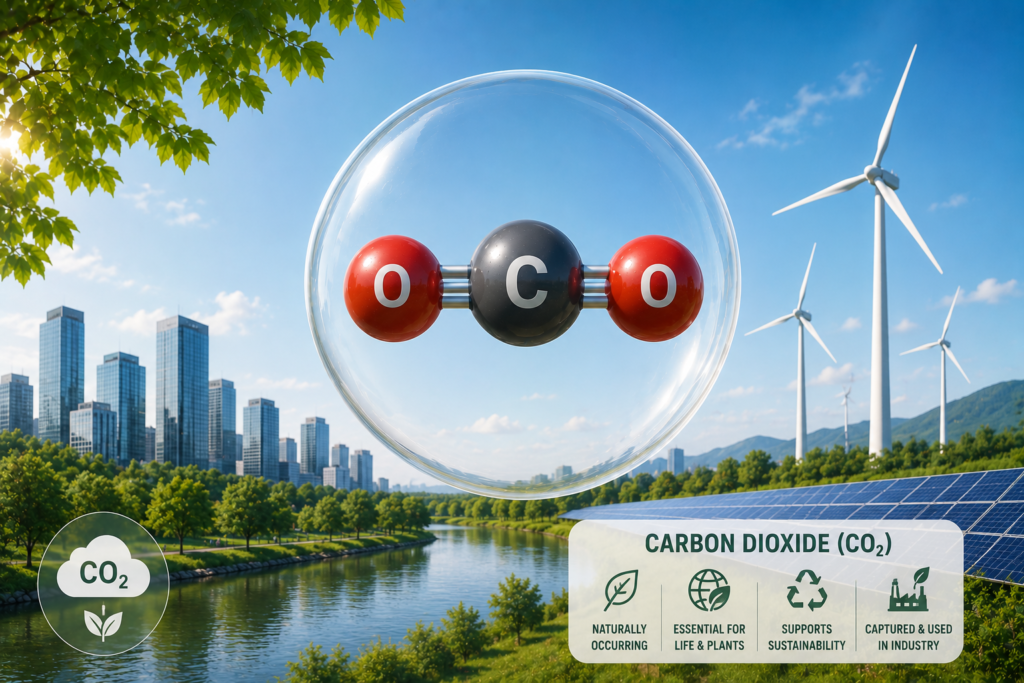
Carbon Dioxide (CO₂): Properties, Uses, Indoor Air Quality and Industrial Applications
Introduction
Carbon dioxide (CO₂) is a naturally occurring gas found in Earth’s atmosphere and produced through respiration, combustion, and industrial activity. It is a colorless gas that is odorless at normal ambient concentrations and highly soluble in water.
CO₂ plays an important role in biological processes, industrial systems, food production, and indoor air quality monitoring. It is widely used across multiple industries including food processing, agriculture, refrigeration, chemical manufacturing, and environmental monitoring.
Because of its widespread presence in both natural and industrial environments, carbon dioxide is one of the most commonly monitored gases worldwide.
Chemical Structure and Properties
CO₂ is composed of one carbon atom bonded to two oxygen atoms. It is chemically stable, nonflammable, and soluble in water.
Key properties:
Colorless gas
Odorless at typical atmospheric concentrations
Nonflammable compound
Highly soluble in water
Denser than air
Stable under normal environmental conditions
When dissolved in water, CO₂ forms carbonic acid, which slightly changes water chemistry.
Natural and Industrial Sources
Carbon dioxide is continuously released and absorbed through natural and industrial processes.
Natural sources:
Respiration of living organisms
Decomposition of organic material
Volcanic activity
Forest and vegetation processes
Ocean-atmosphere exchange
Industrial and technical sources:
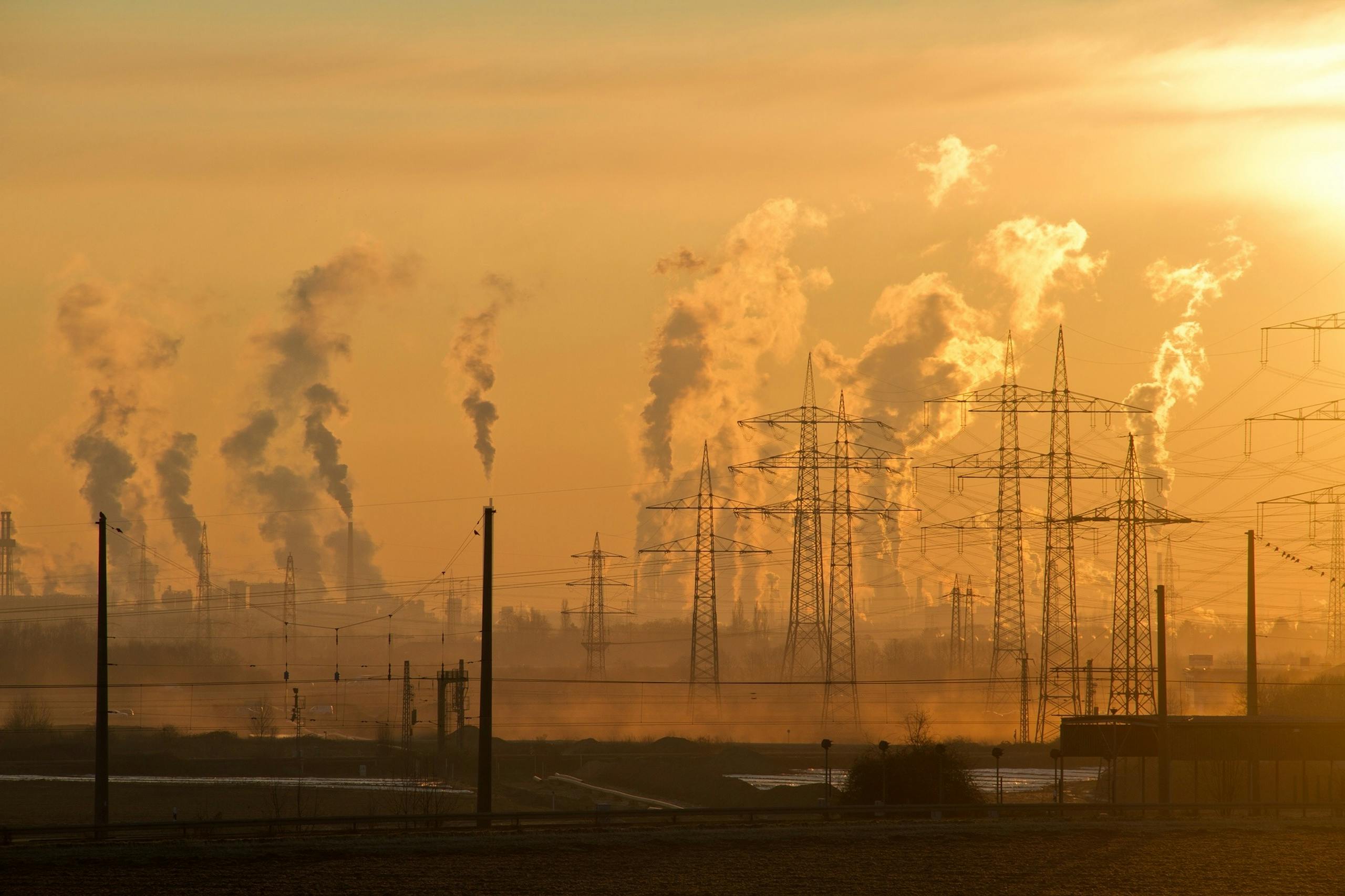
Combustion systems
Power generation
Transportation emissions
Industrial manufacturing
Food and beverage production
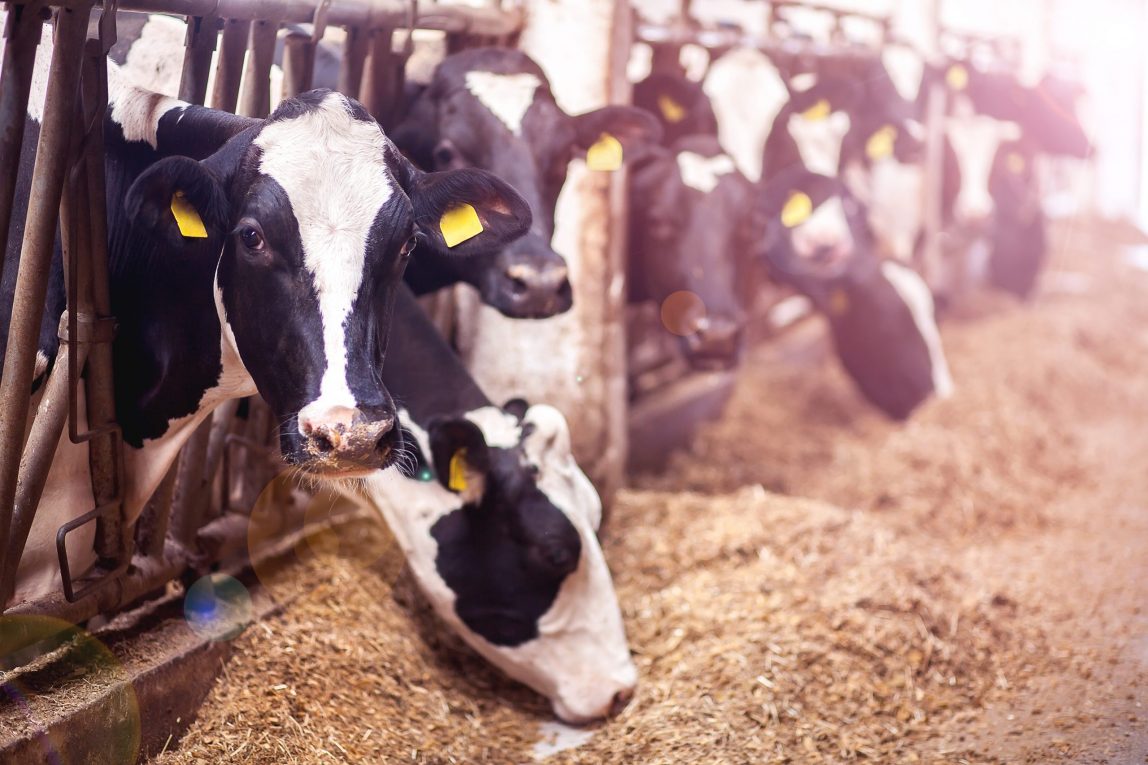
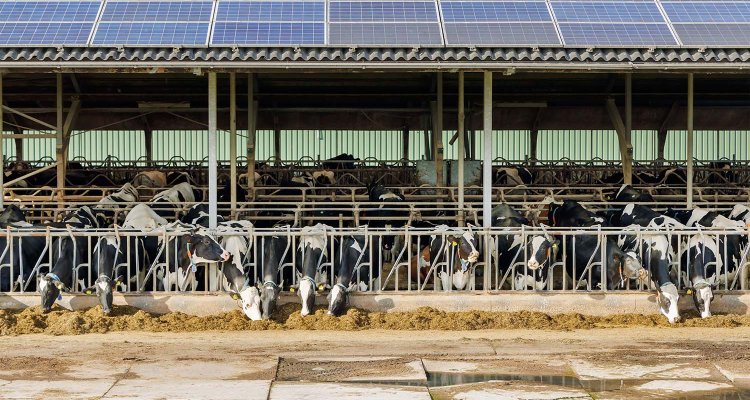
Agricultural operations
Modern industrial activity contributes significantly to atmospheric concentrations in urban and industrial environments.
Industrial Uses of CO₂
Carbon dioxide is widely used in industrial and commercial applications because of its physical and chemical properties.
Main applications include:
Food and beverage carbonation
Industrial refrigeration systems
Greenhouse agriculture
Chemical processing
Fire suppression systems
Welding applications
Laboratory and calibration gases
Liquefied CO₂ is commonly used in cooling systems and food transportation because of its efficient thermal properties.
Industrial Applications Table
| Sector | Application | Interesting Detail | Technical Importance |
|---|---|---|---|
| Food Industry | Used for carbonation and food preservation | Essential for beverage production worldwide | Improves product shelf life |
| Agriculture | Used in greenhouse atmosphere control | Can support controlled plant growth | Important in modern greenhouse systems |
| Refrigeration | Used in industrial cooling systems | Acts as an efficient refrigerant | Widely used in commercial facilities |
| Fire Protection | Used in fire suppression systems | Suitable for electrical equipment areas | Leaves no residue after discharge |
| Chemical Industry | Used in manufacturing and processing systems | Important industrial process gas | Supports multiple production methods |
Indoor Air Quality and Ventilation
Indoor CO₂ concentration is commonly used as an indicator of ventilation efficiency and air exchange performance.
Poor ventilation may cause elevated concentrations in:
Schools
Offices
Conference rooms
Industrial facilities
Public transportation systems
Monitoring indoor air conditions helps improve:
Ventilation performance
Occupant comfort
Air circulation efficiency
Building management systems
Modern buildings increasingly use automated monitoring systems to optimize indoor environmental conditions.
CO₂ Monitoring and Detection Systems
Continuous monitoring is important in industrial, commercial, and indoor applications.
Monitoring systems help:
Track indoor air conditions
Optimize ventilation systems
Improve industrial process efficiency
Support environmental measurements
Detect changes in air quality
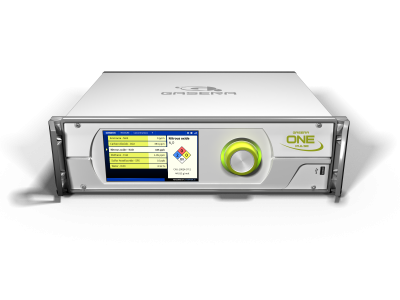
Advanced analyzers are commonly used in:
Laboratories
Industrial facilities
Agricultural systems
Indoor air quality applications
Research environments
👉 More information:
Gasera
EPA Greenhouse Gas Information
CO₂ and Other Industrial Gases
Carbon dioxide is often compared with gases such as carbon monoxide because both are produced during combustion processes.
Key differences:
CO₂ forms during complete combustion
Carbon monoxide forms during incomplete combustion
CO₂ is commonly used in industrial systems
Carbon monoxide is primarily monitored for safety purposes
Both gases are important in air quality analysis
Understanding these differences is important in industrial monitoring and environmental measurements.
Applications in Modern Technology
CO₂ continues to play an important role in modern industrial and technical systems.
Current applications include:
Smart ventilation systems
Industrial automation
Environmental monitoring technologies
Controlled agriculture systems
Food preservation technologies
Industrial refrigeration development
Technological improvements continue to expand the efficiency and usability of CO₂-based systems.
Conclusion
Carbon dioxide (CO₂) is an important atmospheric and industrial gas widely used in food production, refrigeration, agriculture, chemical processing, and air quality monitoring. Its stable properties and broad range of applications make it essential in many modern industrial systems.
Continuous monitoring, efficient ventilation, and advanced industrial technologies help ensure effective and controlled use across commercial, technical, and environmental applications.
Related products and applications:
GASERA ONE GHG
GASERA ONE PULSE
MULTIPOINT SAMPLER
GREENHOUSE GAS