HYDROGEN CHLORIDE (HCl): PROPERTIES, USES, HEALTH RISKS, AND ENVIRONMENTAL IMPACT
Introduction to Hydrogen Chloride (HCl)
Hydrogen Chloride (HCl) is a colorless, pungent gas widely used in industrial chemistry. It plays a critical role in chemical manufacturing because it easily forms hydrochloric acid when dissolved in water. This makes it an essential intermediate in many industrial processes such as pharmaceuticals, metallurgy, and electronics production.
When released into moist air, Hydrogen Chloride rapidly forms hydrochloric acid aerosols, which can be corrosive and irritating to both humans and the environment.
Chemical Properties of Hydrogen Chloride (HCl)
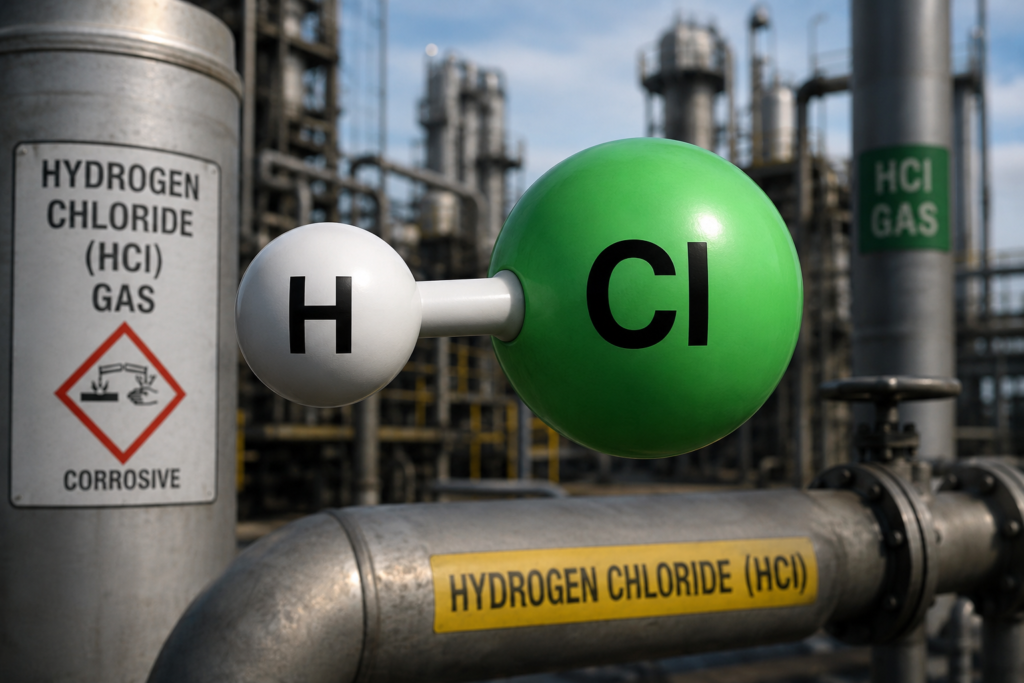
Hydrogen Chloride is a diatomic molecule composed of hydrogen and chlorine atoms connected by a polar covalent bond. It reacts strongly with water and forms a highly acidic solution.
Key properties:
- Colorless gas with sharp odor
- Highly soluble in water
- Forms hydrochloric acid upon contact with moisture
- Strongly acidic in aqueous solution
- Corrosive to metals and organic tissue
- Heavier than air in gas form
Hydrogen Chloride (HCl) Industrial Uses
Hydrogen Chloride is widely used as both a gas and in aqueous form (hydrochloric acid) in industrial production systems.
Main applications:
- Hydrochloric acid production
- Chemical synthesis of chlorinated compounds
- Metal processing and cleaning
- Pharmaceutical manufacturing
- Oil refining processes
- Semiconductor production
Hydrogen Chloride Industrial Applications (Table 1 – 5 Key Sectors)
| Chemical Industry | Used in production of chlorides, solvents, and chemical intermediates |
| Metal Industry | Used for pickling steel and removing rust and oxide layers |
| Oil & Gas Industry | Used in well acidizing to enhance oil and gas extraction |
| Electronics Industry | Used in semiconductor wafer cleaning and etching processes |
| Pharmaceutical Industry | Used in synthesis of active pharmaceutical ingredients (APIs) |
Hydrogen Chloride Health Risks and Exposure
Hydrogen Chloride gas is corrosive and can irritate tissues when inhaled or when it comes into contact with moisture.
Health effects include:
- Eye and respiratory irritation
- Coughing and breathing difficulty
- Severe lung irritation at high exposure
- Chemical burns on mucous membranes
- Long-term respiratory sensitivity
Even low concentrations can cause irritation due to rapid acid formation in moist tissues.
Mechanism of Toxicity of Hydrogen Chloride
When Hydrogen Chloride contacts moisture in the human body, it forms hydrochloric acid, which leads to tissue damage.
Effects include:
- Protein denaturation
- Cellular irritation
- Inflammation of respiratory tract
- Local tissue damage
Environmental Impact of Hydrogen Chloride
Hydrogen Chloride emissions can contribute to atmospheric acidification and environmental stress.
Environmental risks:
- Acid aerosol formation
- Soil acidification
- Water contamination
- Vegetation damage
- Acid rain contribution
Hydrogen Chloride Safety Measures
Proper handling of Hydrogen Chloride requires strict safety protocols.
Safety measures:
- Corrosion-resistant equipment
- Proper ventilation systems
- Gas detection and monitoring
- Protective clothing and respirators
- Controlled storage systems
Hydrogen Chloride Monitoring and Control
Continuous monitoring is essential in industrial environments to ensure safety and compliance.
Monitoring helps:
- Detect leaks early
- Protect workers
- Reduce emissions
- Improve process safety
👉 More information:
https://www.echa.europa.eu/
Hydrogen Chloride Compared to Hydrochloric Acid
Hydrogen Chloride is the gaseous form, while hydrochloric acid is its dissolved aqueous form.
Key differences:
- Gas vs liquid state
- Acid forms when exposed to moisture
- Different handling systems
- Similar corrosive behavior
Conclusion
Hydrogen Chloride (HCl) is a critical industrial gas used in chemical production, metallurgy, pharmaceuticals, and electronics. Its ability to form hydrochloric acid makes it extremely valuable in industrial chemistry.
However, its corrosive nature requires strict safety measures, continuous monitoring, and proper industrial handling to prevent health and environmental risks.
Please click here (Product Query) to receive more information about GASERA analyzers for HCL monitoring.