SF6 Gas in Electrical Industry – Uses, Properties and Environmental Impact
SF6 gas in electrical industry applications plays a major role in modern power transmission and distribution systems. Sulfur hexafluoride (SF₆) is widely used in gas insulated switchgear, circuit breakers, and other high-voltage equipment because of its exceptional insulation and arc-quenching capabilities. Although SF₆ offers significant technical advantages, its environmental impact has made emission reduction and responsible gas handling increasingly important worldwide.
What Is SF₆ Gas?
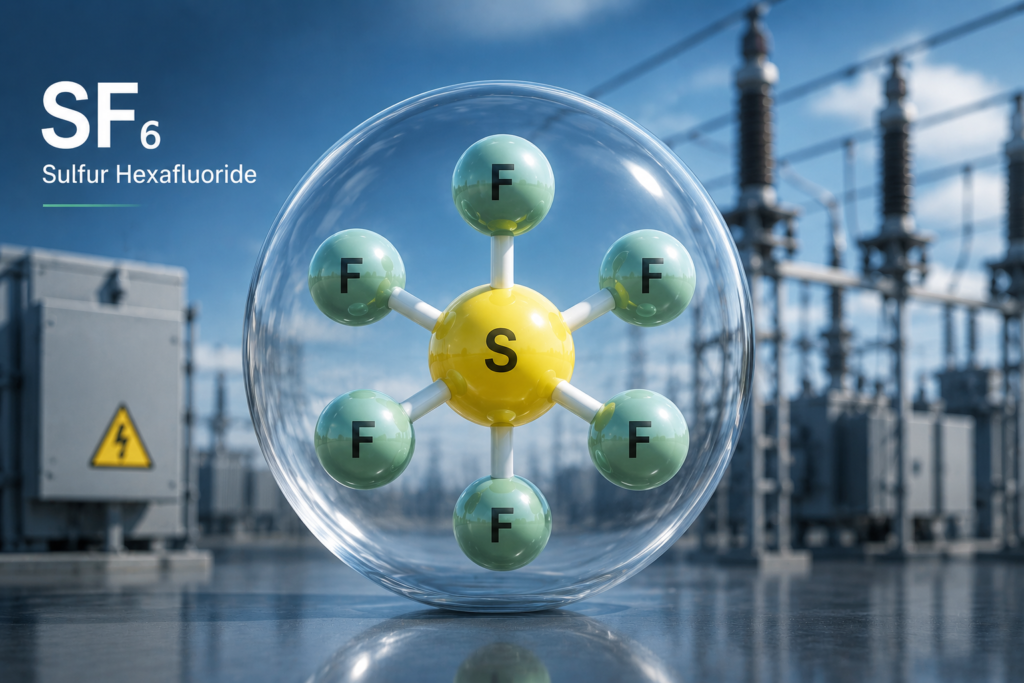
Sulfur hexafluoride (SF₆) is a synthetic gas composed of one sulfur atom and six fluorine atoms. It is colorless, odorless, non-flammable, and chemically stable under normal operating conditions.
The gas became widely adopted in the electrical power sector because of its outstanding dielectric strength and arc suppression properties. Compared to air, SF₆ can provide significantly better insulation performance, allowing electrical systems to become smaller, safer, and more reliable.
Today, approximately 80% of all produced SF₆ is used in the electrical power industry.
Key characteristics of SF₆ include:
- Excellent electrical insulation
- Strong arc-quenching performance
- High thermal stability
- Non-flammable behavior
- Long operational lifetime
- Reliable performance in sealed systems
Because of these characteristics, SF₆ remains one of the most important insulating gases used in modern electrical infrastructure.
Why SF6 Gas in Electrical Industry Applications Is Important
The global electrical grid depends on highly reliable transmission and distribution systems. SF₆ helps operators achieve compact and efficient designs that can safely handle very high voltages.
Without SF₆ technology, many urban substations and industrial electrical systems would require significantly larger installations.
Main Benefits of SF₆ in Power Systems
| Compact Equipment | High Reliability |
|---|---|
| Smaller substations | Long service life |
| Reduced space requirements | Stable insulation performance |
| Better protection from contamination | Reliable switching operations |
| Easier installation in urban areas | Lower maintenance frequency |
Gas insulated switchgear (GIS) systems especially benefit from SF₆ because they can operate reliably even in demanding environmental conditions such as:
- Humid climates
- Offshore installations
- Industrial environments
- Underground substations
- Renewable energy facilities
Main Uses of SF6 Gas in Electrical Industry Systems
SF₆ is used in multiple types of electrical equipment where insulation and fault interruption are critical.
Common Applications
| Equipment Type | Typical Purpose |
|---|---|
| Gas insulated switchgear (GIS) | High-voltage insulation |
| Circuit breakers | Arc interruption |
| Transformers | Electrical insulation |
| Transmission systems | Reliable power distribution |
| Renewable energy systems | Compact electrical infrastructure |
The gas is especially important in high-voltage applications because it enables compact equipment design while maintaining excellent operational safety.
In modern cities where available space is limited, GIS systems using SF₆ can be installed indoors or underground, making them ideal for urban infrastructure projects.
Electrical Properties of SF₆
One of the main reasons SF₆ became widely adopted is its superior dielectric strength.
SF₆ has a dielectric performance approximately two to three times greater than air under similar conditions. This allows electrical systems to operate safely at very high voltages while remaining compact.
The gas also has exceptional arc-quenching capability. During switching operations, electrical arcs can form between contacts inside circuit breakers. SF₆ rapidly absorbs free electrons and cools the arc, helping safely interrupt electrical faults.
These properties make SF₆ highly effective for:
- Power grid protection
- High-voltage switching
- Electrical insulation
- Safe fault interruption
- Reliable long-term operation
Environmental Impact of SF6 Gas in Electrical Industry Equipment
Although SF₆ offers major technical advantages, it is also recognized as one of the most potent greenhouse gases currently regulated internationally.
SF₆ has a Global Warming Potential (GWP) of approximately 22,800 over a 100-year period. This means it traps significantly more heat in the atmosphere than carbon dioxide.
The gas also has an extremely long atmospheric lifetime.
Because of this, reducing emissions has become a major priority for:
- Utilities
- Transmission operators
- Equipment manufacturers
- Environmental agencies
- Industrial facilities
Modern electrical systems are therefore designed with extremely low leak rates and advanced sealing technologies.
Why SF₆ Emissions Occur
Even though gas insulated systems are sealed, emissions can still occur over time due to:
- Aging components
- Seal degradation
- Maintenance procedures
- Improper gas handling
- Transportation losses
- Mechanical failures
Most leaks are very small, but because SF₆ has such a high environmental impact, even minimal emissions matter.
Monitoring SF6 Gas in Electrical Industry Infrastructure
Monitoring systems play an important role in reducing SF₆ emissions and maintaining operational safety.
Modern SF₆ analyzers can detect extremely low gas concentrations and identify leaks at an early stage.
Key Benefits of Monitoring Systems
| Environmental Benefits | Operational Benefits | Safety Benefits |
|---|---|---|
| Lower greenhouse gas emissions | Reduced downtime | Improved workplace safety |
| Better emission reporting | Predictive maintenance | Early warning systems |
| Regulatory compliance | Improved reliability | Gas accumulation detection |
Continuous monitoring helps operators:
- Detect microleaks
- Quantify emission rates
- Improve maintenance planning
- Prevent unexpected failures
- Reduce environmental impact
Advanced systems can also provide real-time alarms and automated reporting for large electrical installations.
SF₆ as a Tracer Gas
In addition to electrical applications, SF₆ is widely used as a tracer gas because it can be detected at extremely low concentrations.
Tracer gas investigations are commonly used in:
- HVAC airflow studies
- Building leakage analysis
- Ventilation efficiency testing
- Industrial process investigations
- Cleanroom testing
Because SF₆ is chemically stable and highly detectable, it is ideal for airflow and leakage studies in complex environments.
SF₆ Lifecycle Management
Modern SF₆ management strategies focus on minimizing emissions throughout the entire lifecycle of the gas.
Three Critical Areas of SF₆ Management
| Prevention | Monitoring | Recovery |
|---|---|---|
| Leak-resistant equipment | Continuous gas measurement | Gas recycling systems |
| Proper installation procedures | Early leak detection | Recovery during maintenance |
| Personnel training | Emission documentation | End-of-life gas handling |
Utilities and industrial operators increasingly implement strict procedures for:
- Gas filling
- Recovery and recycling
- Leak testing
- Emission documentation
- Safe transportation
- Responsible disposal
These practices help reduce environmental impact while maintaining reliable power infrastructure.
Future Alternatives to SF6 Gas in Electrical Industry Applications
The electrical industry is actively researching alternatives to SF₆ because of environmental concerns.
Several technologies are currently being developed, including:
- Vacuum switching systems
- Clean air insulation
- Hybrid insulation technologies
- Fluoronitrile-based gas mixtures
However, replacing SF₆ completely remains technically challenging in many high-voltage applications.
The gas still offers a unique combination of:
- Compactness
- Reliability
- Safety
- Long operational lifetime
- Excellent insulation capability
Because of this, SF₆ is expected to remain important in critical electrical infrastructure for years to come.
The Future of SF₆ Monitoring and Emission Reduction
As sustainability targets continue to evolve, the electrical power industry is investing heavily in:
- Advanced leak detection technologies
- Improved gas recovery systems
- Continuous monitoring solutions
- Better sealing technologies
- Automated reporting systems
The goal is to minimize emissions while maintaining reliable operation of high-voltage electrical infrastructure.
Modern monitoring technologies now allow operators to detect extremely small leaks before they become significant environmental or operational problems.
Conclusion
SF6 gas in electrical industry applications remains essential for modern power transmission and distribution systems. Its excellent insulation properties, compact design advantages, and reliable arc-quenching capabilities have made SF₆ one of the most widely used gases in high-voltage electrical equipment worldwide.
At the same time, the environmental impact of SF₆ has increased the importance of responsible gas handling, emission reduction, and continuous monitoring.
As the industry develops new technologies and alternative solutions, effective SF₆ management will continue to play a key role in balancing reliable electrical infrastructure with environmental responsibility.
External Resources
International Energy Agency (IEA)
https://www.iea.org/
IPCC Greenhouse Gas Information
https://www.ipcc.ch/
International Electrotechnical Commission (IEC)
https://www.iec.ch/
Related products and applications:
GASERA ONE PULSE
MULTIPOINT SAMPLER
SF6 LEAK RATE QUANTIFICATION (INTEGRAL TEST)